
Nobody becomes a great SOC analyst by avoiding mistakes entirely — they become great by learning which mistakes actually matter and fixing the habits behind them. Most of the errors that hurt detection and response aren’t dramatic, one-time blunders. They’re small, repeatable habits that quietly erode effectiveness over weeks and months. Here are the ones that show up again and again, especially in analysts early in their career — and what to do instead.
1. Treating Every Alert the Same Way
Not every alert deserves the same depth of investigation, but it’s a common early-career habit to work the queue top-to-bottom without triaging severity first. The result is time spent thoroughly investigating a low-risk false positive while a higher-priority alert sits untouched further down the list.
Fix: Build the habit of a fast severity pass before diving into any single alert — a quick scan of the whole queue to flag anything that looks like it could indicate active compromise, before committing deep investigation time to any one ticket.
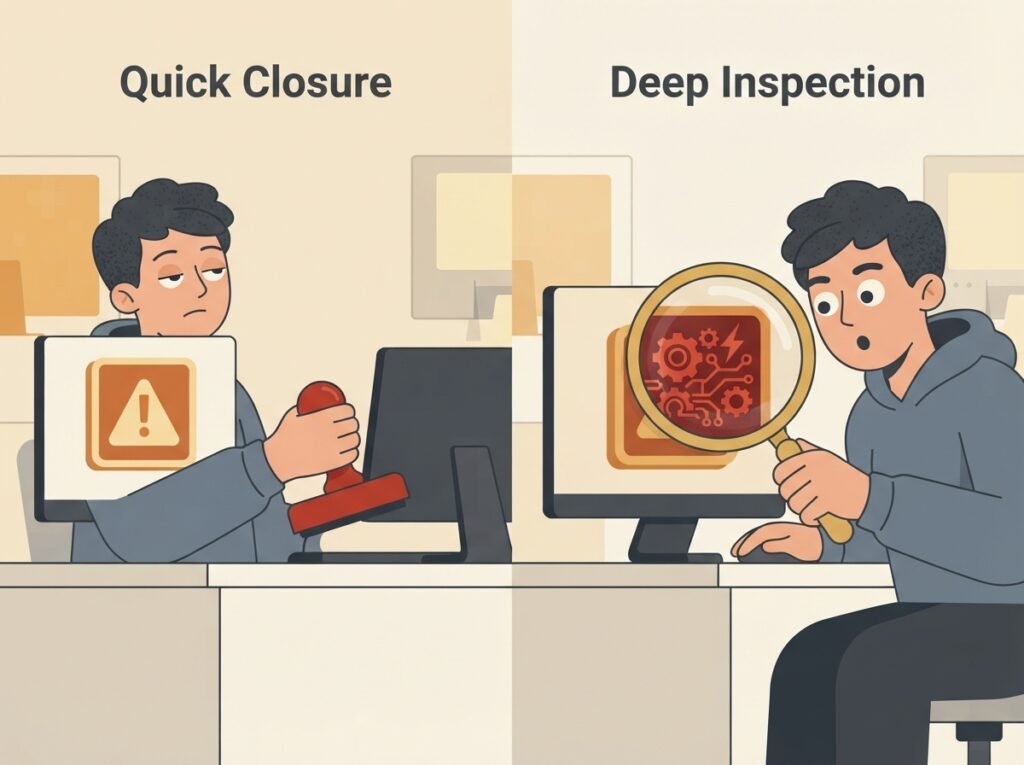
2. Closing Alerts Too Quickly to Clear the Queue
Queue pressure is real, and it’s tempting to mark something as a false positive the moment it looks routine, just to keep the numbers moving. This is one of the most common — and most dangerous — mistakes, because attackers count on exactly this kind of rushed dismissal.
Fix: A closed ticket should be closed because the evidence supports it, not because the shift is almost over. When in doubt, a brief note and an escalation to a second set of eyes costs far less than a missed intrusion.
3. Not Documenting the “Why,” Only the “What”
It’s common to log what action was taken on an alert — blocked, escalated, closed — without capturing the reasoning behind that decision. Months later, during an audit or a similar incident, that missing context makes it hard to know whether the original call was even sound.
Fix: A good ticket note answers “why did I decide this,” not just “what did I do.” Future you — and every analyst who inherits a similar alert later — will thank present you.
4. Working in Isolation Instead of Asking for a Second Opinion
New analysts especially tend to sit with an ambiguous alert far longer than necessary, reluctant to ask a teammate for a second opinion out of fear it looks like they don’t know what they’re doing. In reality, pattern recognition in security work is built collectively — a five-minute conversation with a more experienced analyst often resolves in minutes what would otherwise take an hour of solo digging.
Fix: Treat asking for a second opinion as a sign of good judgment, not a weakness. The best SOC teams have a low-friction culture around this — a quick message in a shared channel, not a formal request.

5. Chasing the Interesting Alert Instead of the Risky One
It’s human nature to gravitate toward the alert that looks technically interesting — an unusual process name, an exotic-looking payload — over the alert that’s actually more likely to represent real risk, like a routine-looking failed login from an unusual geography on a privileged account.
Fix: Risk should drive prioritization, not curiosity. It’s fine to come back to the interesting puzzle later; it’s not fine to let a boring, high-risk alert wait for it.
6. Ignoring Context Outside the Alert Itself
An alert rarely tells the whole story on its own. A mistake many analysts make is investigating an alert in isolation — without checking whether the same user, host, or IP has shown up anywhere else recently, or whether there’s relevant business context (a scheduled maintenance window, a new employee’s first week, a known vendor integration).
Fix: Before closing or escalating, take thirty seconds to ask “what else do I know that’s relevant here?” That context often changes the entire read on an alert.
7. Letting Tool Fatigue Replace Actual Verification
When a platform is trusted and reliable, it’s easy to let its verdict become the final word — closing an alert because “the tool marked it low confidence” without doing an independent sanity check. Tools are genuinely useful, but they’re inputs to judgment, not a replacement for it.
Fix: Treat automated verdicts as a strong starting point, not a conclusion. A quick manual gut-check, especially on anything touching a sensitive system or privileged account, catches the rare cases where the tool got it wrong.

8. Neglecting Their Own Burnout
This one isn’t a technical mistake, but it drives most of the others. Alert fatigue and shift-work exhaustion are chronic issues in SOC roles, and analysts who push through burnout without acknowledging it tend to make more of every mistake on this list — rushing closures, skipping context checks, avoiding collaboration because it feels like more effort than it’s worth.
Fix: Burnout isn’t a personal failing to push through quietly — it’s an operational risk to the whole team’s detection quality. Raising it with a lead isn’t weakness; it’s part of doing the job well.
The Pattern Behind All of These
Almost every mistake on this list comes down to the same root cause: pressure to move fast colliding with work that genuinely requires care. The fix isn’t “try harder” — it’s building small habits (a severity pass, a documented reason, a quick second opinion) that make the careful path just as fast as the rushed one. The analysts who avoid these mistakes consistently aren’t necessarily more skilled than everyone else. They’ve just built better defaults.
This post is part of an ongoing series on the realities of SOC work. If you’re building your own OSINT or SOC skill set in 2026, these habits matter just as much as any tool on your desk.
Leave a Reply