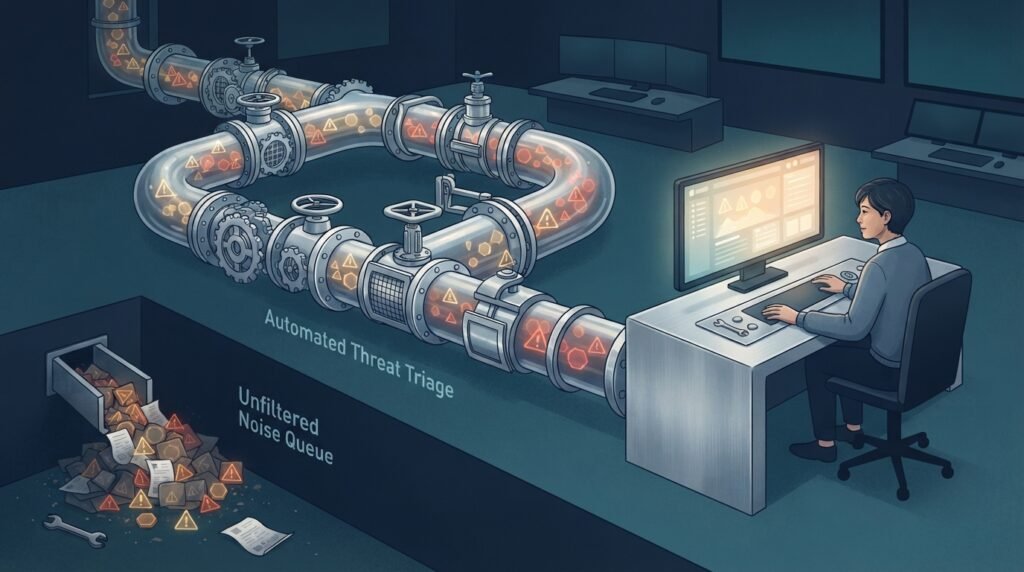
Every SOC eventually hits the same wall: alert volume grows faster than headcount ever can. That’s the gap SOAR — Security Orchestration, Automation, and Response — is built to close. But SOAR gets talked about in two very different ways: as a silver bullet that finally ends alert fatigue, or as an overhyped tool that just moves the same chaos somewhere else. The truth, as usual, sits in between.
What SOAR Actually Is
SOAR platforms sit on top of a SOC’s existing tools — SIEM, EDR, threat intelligence feeds, ticketing systems — and connect them together through automated workflows called playbooks. Instead of an analyst manually pulling context from five different tools every time a phishing alert comes in, a SOAR playbook can automatically check sender reputation, pull related alerts for the same user, quarantine the email across the mailbox, and open a pre-populated ticket — all before a human even looks at it.
The core value proposition is straightforward: take the repetitive, well-defined parts of alert handling and let a machine do them consistently and instantly, freeing analysts to spend their time on the judgment calls that actually need a human.

What SOAR Genuinely Fixes
Repetitive triage work disappears. The alerts that follow a predictable, well-understood pattern — a known-bad IP hitting a firewall rule, a routine phishing report, a standard malware signature match — are exactly what playbooks handle well. Automating these frees up meaningful analyst time.
Response time shrinks dramatically. A playbook can isolate a compromised endpoint or block a malicious domain in seconds, long before a human could have finished reading the alert. For fast-moving threats, that speed difference is often the entire ballgame.
Consistency improves. A tired analyst on hour ten of a night shift might skip a step under pressure. A playbook doesn’t get tired, and it runs the same checklist every single time — which matters enormously for compliance and audit trails.
Context-gathering gets automated. Instead of an analyst manually pivoting across four tools to build a picture of what’s going on, a playbook can pull all of that together instantly and hand the analyst a pre-enriched alert, cutting investigation time significantly.
Where SOAR Falls Short (and Why That Matters)
It doesn’t fix bad alert quality. SOAR automates handling — it doesn’t fix the underlying problem if your detection rules are poorly tuned and generating too much noise in the first place. Automating a bad process just makes the bad process run faster.
Playbooks need real maintenance. A playbook built for last year’s threat landscape can quietly go stale, missing new attack patterns or automating a response that no longer fits how the environment has changed. SOAR isn’t “set it and forget it” — it requires ongoing tuning, arguably as much attention as the detection rules themselves.
It can create false confidence. There’s a real risk of teams assuming that because a playbook ran, the alert was properly handled — even when the situation called for human judgment the playbook wasn’t built to apply. Automation should reduce workload, not reduce scrutiny on the cases that actually need it.
Complex, novel threats still need a human. SOAR is excellent at the well-defined, repeatable 80% of alert volume. The remaining, messier cases — the ones involving ambiguous context, unusual business circumstances, or a genuinely new attack pattern — still need an analyst’s judgment, and probably always will.

Getting SOAR Right: What Actually Matters
Teams that get real value out of SOAR tend to share a few habits:
- They start narrow. Rather than trying to automate everything at once, successful rollouts pick a handful of high-volume, well-understood alert types first — phishing triage is a common starting point — and expand from there once the playbooks are proven.
- They keep a human checkpoint on anything ambiguous. Full auto-remediation is reserved for low-risk, high-confidence scenarios; anything touching a privileged account or a critical system typically still routes through a human approval step.
- They treat playbooks as living documents. Regular review cycles catch playbooks that have drifted out of sync with the current environment or threat landscape.
- They measure the right thing. The goal isn’t “more alerts closed automatically” — it’s faster response on genuine threats and more analyst time freed up for the investigations that need real thinking. Teams that only track automation volume can end up optimizing for the wrong outcome.
The Bottom Line
SOAR doesn’t replace SOC analysts, and any platform sold on that promise is overselling it. What it actually does is change the shape of an analyst’s day — less time spent on repetitive lookups and manual context-gathering, more time spent on the judgment calls that genuinely need a person. Used well, that’s not a minor efficiency gain; it’s the difference between a SOC that’s constantly drowning in its own queue and one that has room to actually get ahead of emerging threats.
This post is part of an ongoing series on the realities of SOC work. Up next: a closer look at how AI-assisted threat intelligence platforms are building on top of SOAR to push automation even further into the ambiguous cases.
Leave a Reply