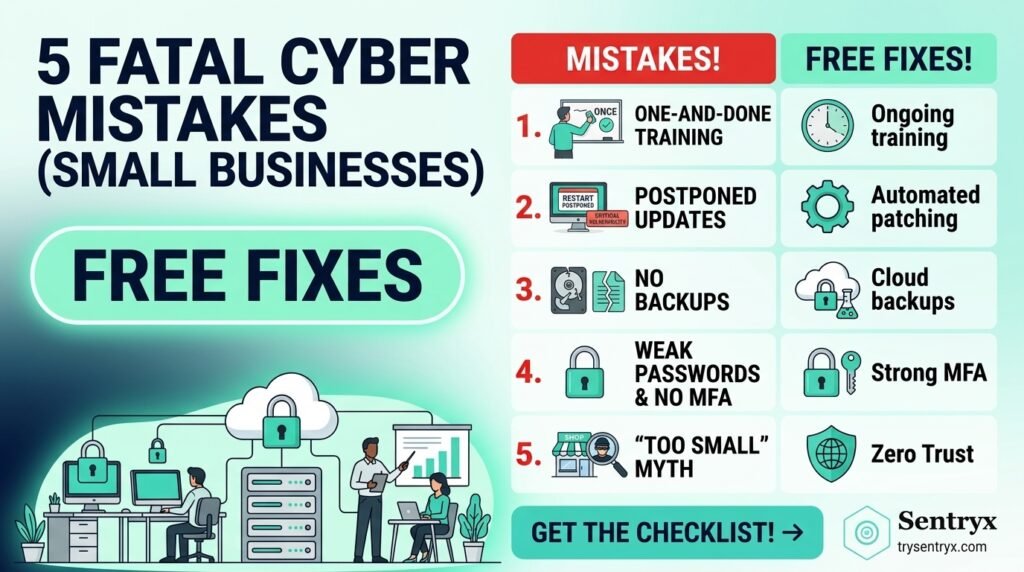
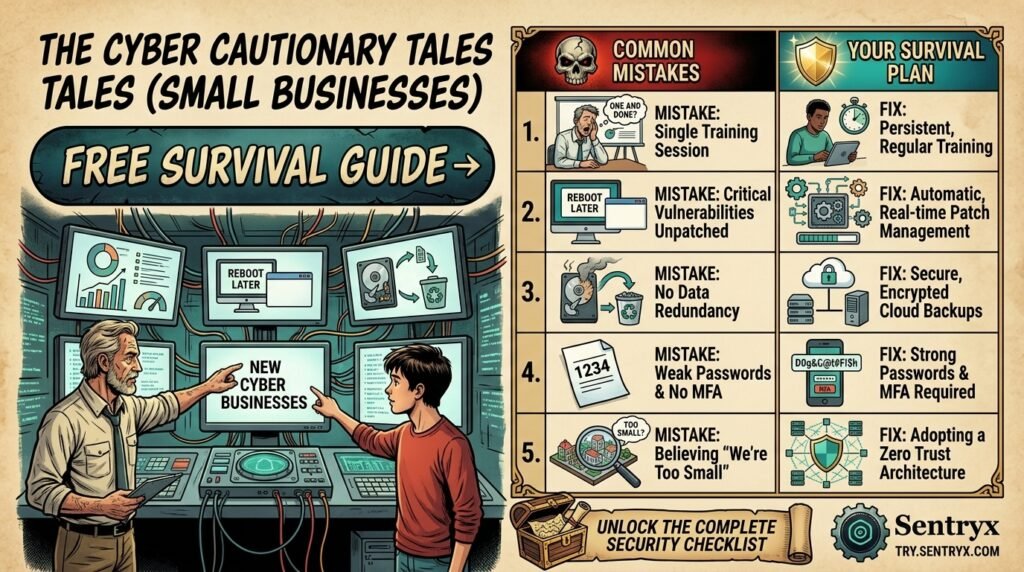
Small businesses often assume hackers only target big corporations. In reality, smaller companies are frequently seen as easier targets because they tend to have fewer defenses in place. A single breach can mean lost revenue, damaged trust, and in some cases, a business that never reopens.
The good news? Most breaches trace back to a handful of avoidable mistakes. Here are the five most costly ones — and what to do instead.
Download the security Checklist
1. Using Weak or Reused Passwords
It’s tempting to reuse the same password across multiple accounts, especially when you’re juggling a dozen logins for banking, email, social media, and business software. But if one account is compromised, every account sharing that password becomes vulnerable too.
The fix:
- Use a password manager to generate and store unique, complex passwords for every account.
- Turn on multi-factor authentication (MFA) wherever it’s available.
- Set a policy requiring password changes after any suspected compromise, not on an arbitrary schedule.
2. Skipping Employee Cybersecurity Training
Technology can only do so much. Most breaches start with a human decision — clicking a phishing link, downloading a malicious attachment, or falling for a fake invoice request. Employees who haven’t been trained to spot these tactics are the easiest way into a business.
The fix:
- Run short, recurring training sessions on phishing, social engineering, and safe browsing habits.
- Simulate phishing emails periodically to reinforce awareness.
- Make reporting a suspicious email easy and blame-free, so employees flag issues instead of hiding mistakes.
3. Delaying Software Updates and Patches
Outdated software is one of the most common entry points for attackers. Every unpatched vulnerability is a known door left open, and cybercriminals actively scan for businesses running old, exploitable versions of common software.
The fix:
- Enable automatic updates for operating systems, browsers, and business applications.
- Keep an inventory of all software and devices so nothing gets forgotten.
- Retire or isolate legacy systems that can no longer be patched.
4. Having No Real Data Backup Strategy
Many small businesses assume backups are “handled” simply because files live in the cloud. But cloud storage isn’t automatically a backup, and ransomware can encrypt synced files just as easily as local ones. Without a tested backup plan, a single attack or hardware failure can wipe out years of records.
The fix:
- Follow the 3-2-1 rule: three copies of your data, on two different media, with one stored off-site or offline.
- Test restoring from backups regularly, not just creating them.
- Automate backups so they don’t depend on someone remembering to run them.
5. Neglecting Network and Device Security
Unsecured Wi-Fi networks, missing firewalls, and personal devices connecting to business systems without oversight all widen the attack surface. Many small businesses set up their network once and never revisit the settings again.
The fix:
- Segment guest Wi-Fi from the network that handles business data.
- Use a firewall and reputable antivirus/endpoint protection on every device.
- Set clear rules for personal devices accessing company systems (BYOD policies).
The Bottom Line
Cybersecurity doesn’t have to mean a massive budget or a dedicated IT department. Most of these fixes are about consistency: unique passwords, trained employees, updated software, tested backups, and a secured network. Small, steady habits close the gaps that attackers rely on most.
If you want a simple way to track where your business stands on each of these risks, grab the companion Small Business Cybersecurity Risk Chttps://mazharian854.gumroad.com/l/rcsiphecklist — a ready-to-use spreadsheet that walks through all five areas with action items and a built-in risk score.